
Subtotal ₦0.00
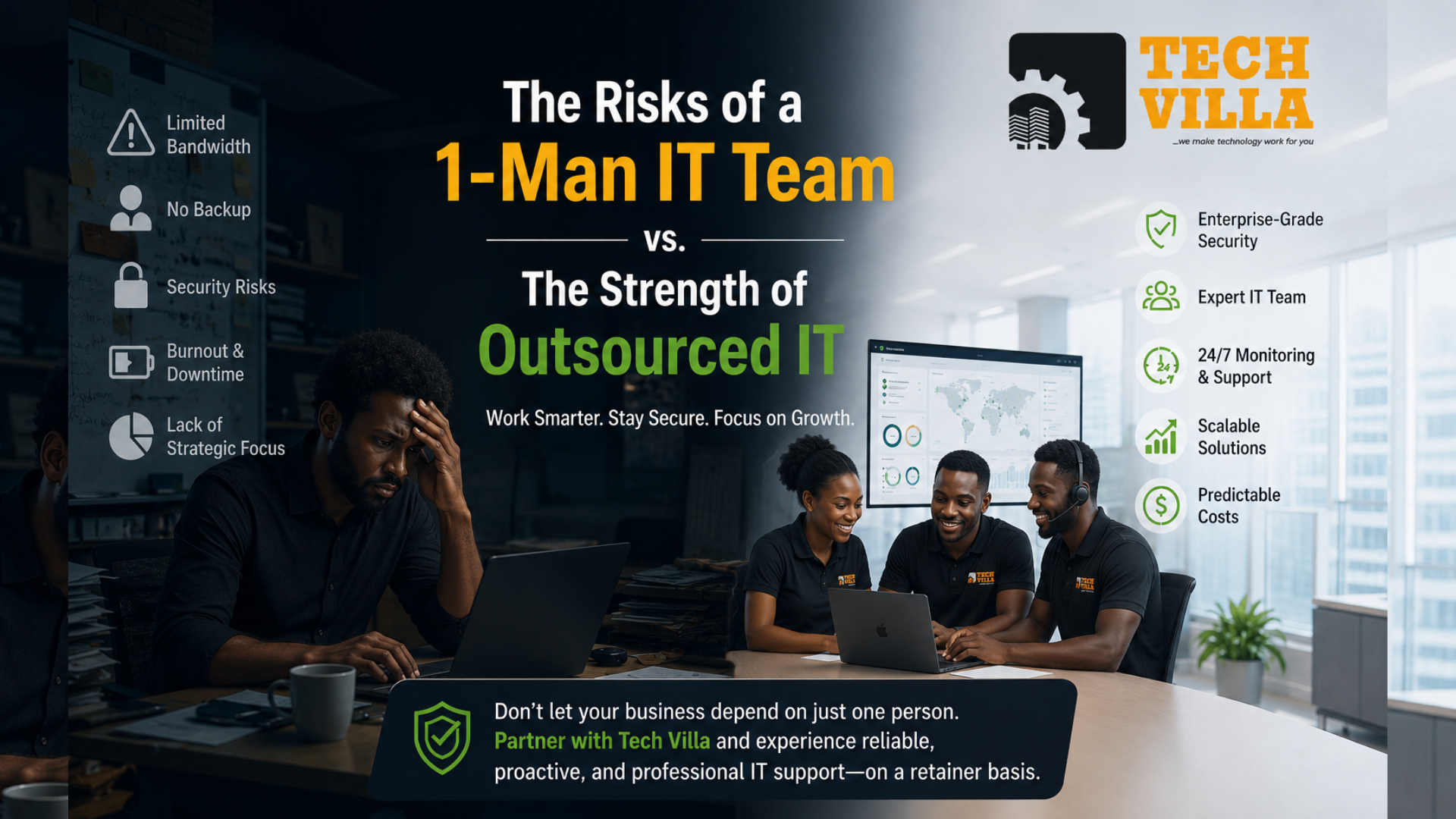
The Hidden Business Risk of a One-Man IT Team: Why Smart Companies Are Moving to Managed IT Outsourcing
In today’s digital economy, technology is no longer a support function operating quietly in the background of business operations. IT systems now sit at the core of communication, customer engagement, finance, operations, security, compliance, and business continuity. As organizations continue to digitize their operations, the reliability, security, and resilience of their IT infrastructure have become mission-critical.
Yet, despite this reality, many organizations, particularly small and mid-sized businesses; still operate with a one-man IT structure. In this model, a single individual is solely responsible for managing the company’s IT infrastructure, systems administration, cybersecurity, user support, vendor coordination, backups, cloud platforms, business applications, and sometimes even strategic technology planning.
While this arrangement may appear cost-effective on the surface, it exposes organizations to significant operational, financial, and security risks.
This article explores the hidden dangers of relying on a one-man IT team and why forward-thinking businesses are increasingly adopting outsourced IT support models through professional technology partners such as Tech Villa.
The Risks of a One-Man IT Structure
1. Single Point of Failure
One of the biggest risks associated with a one-man IT team is the creation of a single point of failure within the organization.
When one individual holds all institutional IT knowledge, system access credentials, infrastructure understanding, vendor relationships, and operational control, the entire business becomes dependent on that individual’s availability and competence.
If the employee:
- Resigns unexpectedly,
- Becomes unavailable,
- Falls ill,
- Goes on leave,
- Experiences burnout, or
- Is terminated without proper handover,
critical business systems may become inaccessible or poorly managed.
In many organizations, this situation results in:
- Loss of administrative access,
- Delayed incident resolution,
- Downtime of essential services,
- Difficulty recovering systems,
- Poor documentation availability, and
- Major business disruption.
No business-critical function should depend entirely on one person.
2. Limited Skill Coverage
Modern IT management is highly specialized.
A single IT personnel is often expected to simultaneously manage:
- Network infrastructure,
- Cybersecurity,
- Cloud platforms,
- User support,
- Email systems,
- Data backup and disaster recovery,
- ERP and business applications,
- Compliance requirements,
- Procurement,
- Website management,
- Digital transformation initiatives, and
- Strategic IT planning.
Realistically, no single professional can possess deep expertise across every technology domain.
As technology environments become more complex, organizations require access to multiple skill sets including:
- Cybersecurity specialists,
- Cloud engineers,
- Infrastructure administrators,
- Compliance advisors,
- Helpdesk support professionals,
- Systems architects,
- Website and application specialists,
- IT governance consultants, and
- Business continuity experts.
A one-man team naturally creates capability gaps that can leave businesses exposed to inefficiencies, vulnerabilities, and poor technology decisions.
3. Increased Cybersecurity Exposure
Cybersecurity threats continue to evolve rapidly, with businesses facing increasing risks from:
- Phishing attacks,
- Ransomware,
- Email compromise,
- Data breaches,
- Insider threats,
- Unauthorized access,
- Cloud misconfigurations, and
- Weak endpoint security.
Organizations with only one IT personnel often struggle to implement and continuously monitor:
- Multi-layered security controls,
- Security audits,
- Vulnerability assessments,
- Access management policies,
- Endpoint protection,
- User awareness training,
- Backup verification,
- Security monitoring, and
- Incident response procedures.
Cybersecurity is no longer a part-time responsibility. It requires continuous oversight, multiple layers of expertise, and proactive monitoring.
A single overwhelmed IT employee may focus primarily on daily operational issues while critical security risks remain unattended.
4. Lack of Business Continuity and Redundancy
Businesses today operate in environments where downtime directly impacts:
- Revenue,
- Customer confidence,
- Productivity,
- Reputation, and
- Operational continuity.
A one-man IT structure often lacks:
- Proper documentation,
- Structured escalation procedures,
- Redundancy planning,
- Team collaboration,
- Standard operating procedures, and
- Continuity frameworks.
When issues occur outside working hours or during periods of unavailability, organizations may experience prolonged downtime simply because no backup technical support structure exists.
In contrast, professional IT outsourcing companies operate with multiple technical personnel, escalation systems, and support continuity models designed to ensure uninterrupted service delivery.
5. Poor Strategic Technology Planning
Most one-man IT teams operate reactively rather than strategically.
The daily pressure of troubleshooting, responding to user complaints, and maintaining operations often leaves little time for:
- Digital transformation planning,
- Infrastructure optimization,
- Process automation,
- IT governance,
- Technology lifecycle management,
- Risk assessments,
- Vendor optimization,
- Compliance alignment, and
- Long-term scalability planning.
As a result, businesses become trapped in survival-mode IT operations instead of leveraging technology as a growth enabler.
Organizations require strategic IT leadership that aligns technology investments with business objectives.
6. Burnout and Productivity Decline
Managing an entire corporate IT environment alone is unsustainable.
One-man IT personnel frequently experience:
- Excessive workloads,
- Constant interruptions,
- Emergency response fatigue,
- After-hours responsibilities,
- Stress-related burnout, and
- Reduced efficiency.
Over time, this not only affects the employee’s wellbeing but also compromises the quality, responsiveness, and reliability of IT support delivered to the organization.
Burnout-driven mistakes in IT management can result in severe operational and security consequences.
The Smarter Alternative: Outsourced IT Services on a Retainer Model
To address these risks, many organizations are transitioning from isolated in-house IT structures to outsourced IT partnership models.
Under this approach, businesses engage a professional IT services company on a retainer basis to provide continuous technology support, management, advisory services, and operational oversight.
Rather than relying on one individual, companies gain access to an entire ecosystem of IT expertise.
Why Businesses Are Outsourcing Their IT Operations
1. Access to a Full Team of Specialists
An outsourced IT partner provides businesses with access to multiple technology professionals with expertise across different areas.
This includes:
- Infrastructure management,
- Cybersecurity,
- Cloud services,
- Helpdesk support,
- Systems administration,
- Website management,
- Backup and disaster recovery,
- Procurement advisory,
- Compliance support, and
- IT strategy consulting.
Instead of depending on one individual, businesses benefit from a diversified technical support structure.
2. Improved Reliability and Business Continuity
A professional IT outsourcing company operates structured support systems with:
- Multiple technical personnel,
- Ticket escalation procedures,
- Documentation standards,
- Monitoring systems,
- Backup support coverage, and
- Service continuity frameworks.
This significantly reduces operational risks associated with staff absence or turnover.
3. Stronger Cybersecurity Posture
Outsourced IT providers typically maintain stronger cybersecurity capabilities through:
- Security best practices,
- Proactive monitoring,
- Security policy implementation,
- Endpoint management,
- Access control management,
- Backup verification,
- User awareness initiatives, and
- Incident response preparedness.
This helps organizations maintain stronger protection against evolving cyber threats.
4. Predictable and Cost-Effective IT Management
Hiring and maintaining multiple in-house IT professionals can be expensive.
An outsourced retainer model allows businesses to:
- Reduce recruitment costs,
- Minimize training expenses,
- Lower infrastructure management overhead,
- Access enterprise-level expertise at lower cost, and
- Predict IT operational spending through structured monthly retainers.
This creates a more scalable and financially efficient IT management structure.
5. Strategic Technology Partnership
Beyond technical support, modern IT outsourcing companies serve as strategic technology advisors.
They help businesses:
- Improve operational efficiency,
- Optimize infrastructure,
- Implement digital transformation initiatives,
- Reduce technology risks,
- Improve business visibility,
- Align IT with business goals, and
- Build scalable technology environments.
This transforms IT from a reactive support function into a strategic business enabler.
Why Companies Choose Tech Villa
As businesses increasingly recognize the risks associated with one-man IT operations, companies are partnering with experienced IT service providers such as Tech Villa to build more resilient, secure, and scalable technology environments.
Tech Villa provides organizations with professional outsourced IT support services designed to eliminate dependency risks while improving operational efficiency and business continuity.
Through a structured retainer-based support model, Tech Villa offers:
- IT infrastructure management,
- Managed IT support services,
- Business visibility and website management,
- Cloud and email administration,
- IT advisory and digital transformation consulting,
- IT staffing and recruitment support,
- Cybersecurity best-practice implementation,
- On-demand technical support,
- Vendor coordination and oversight, and
- Strategic technology guidance.
By partnering with Tech Villa, organizations gain access to an experienced technology team rather than depending on a single internal resource.
This approach improves:
- Operational continuity,
- Security posture,
- Service responsiveness,
- Scalability,
- Technical reliability, and
- Overall business resilience.
Conclusion
The modern business environment demands resilient, secure, and professionally managed technology systems.
While a one-man IT structure may appear sufficient in the short term, it creates significant operational, security, and continuity risks that can severely impact business performance.
Technology has become too critical, and too complex, to depend entirely on one individual.
Organizations seeking long-term stability, improved efficiency, stronger cybersecurity, and scalable growth should consider transitioning to a professional outsourced IT support model.
Partnering with an experienced IT outsourcing company such as Tech Villa allows businesses to reduce risk, improve operational reliability, and gain access to the broader expertise required to thrive in today’s digital economy.
In an era where technology downtime can directly affect revenue, reputation, and business continuity, smart organizations are no longer asking whether they should outsource IT support.
They are asking how quickly they can build a more resilient technology structure.